Two Safe Checks Before You Call
There are exactly two things worth touching yourself, and both are safe. Everything else on a modern AC system involves high voltage, stored electrical charge, or refrigerant under pressure. These two checks take about a minute, occasionally solve the problem outright, and cost you nothing if they do not.
- Thermostat: set to Cool, fan set to Auto. If the fan is on ON rather than AUTO, the blower runs continuously and pushes room-temperature air through the vents between cooling cycles — which feels exactly like an AC that stopped cooling. Drop the setpoint five degrees below room temperature and listen for the outdoor unit to start.
- Outdoor disconnect box. There is a small box on the wall near the condenser. Confirm the pull-out is seated and the switch is on. Service work, a power event, or someone tidying the side yard can leave it out, and the indoor blower keeps running while the outdoor unit sits dead.
Where the DIY stops
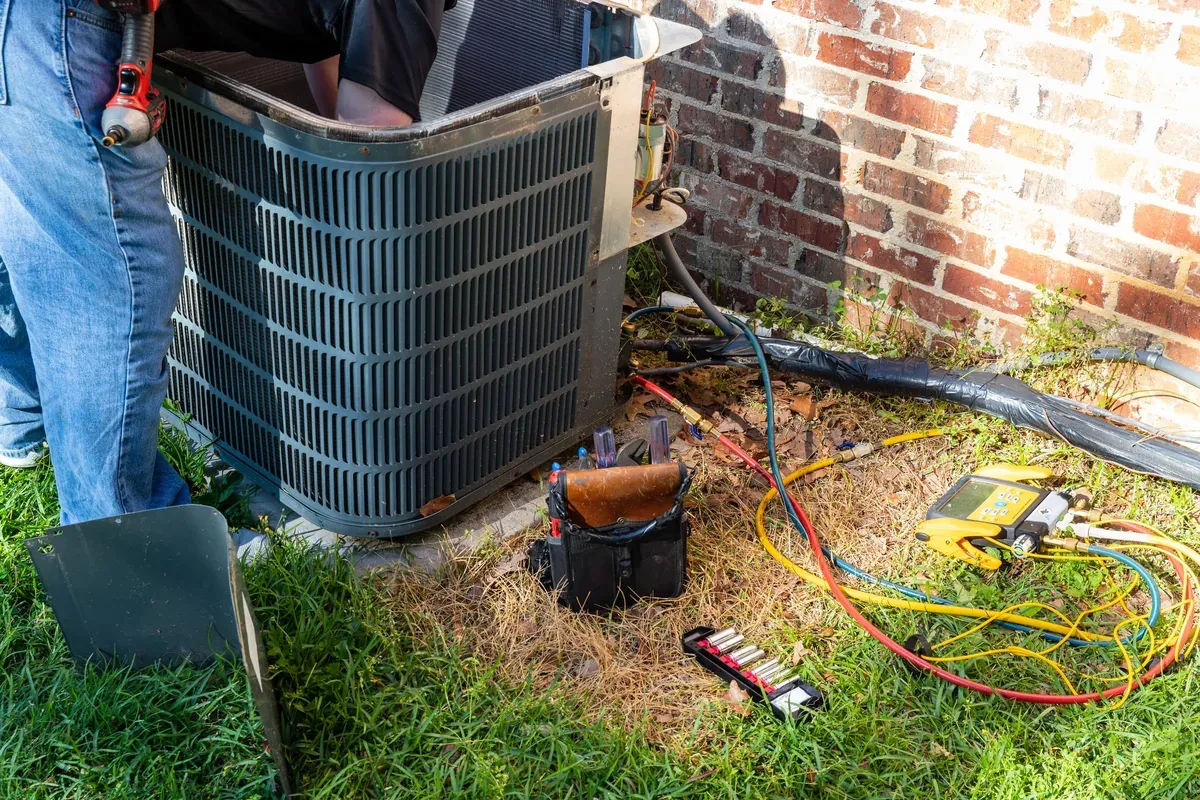
Do not remove the panels on the outdoor unit, and do not touch the capacitor. Capacitors store a dangerous electrical charge even after the power is off, and they are the most common failure on this list — which is exactly why people are tempted. Leave the cap to the tech. Refrigerant work is also off-limits: it requires EPA Section 608 certification.
Match Your Symptom to the Likely Cause
Four failures account for most no-cooling calls in Pahrump Valley, and each one announces itself differently. Work down this table to the row that matches what your system is doing, then tell the dispatcher what you found — it often gets the right part loaded on the truck before anyone leaves the shop.
| What you observe | Likely cause | Typical repair |
|---|---|---|
| Outdoor unit hums, fan blade sits still | Failed start capacitor | $100 – $250 |
| Runs constantly, house never catches up, bill climbing | Dust-choked condenser coil | $100 – $300 |
| Weak airflow, ice on the indoor coil or refrigerant line | Frozen coil from a clogged filter or blocked return | Filter + diagnostic $75 – $150 |
| Weak cooling, hissing, ice that returns after thawing | Refrigerant leak and low charge | $200 – $1,500 |
| Nothing runs at all, breaker trips repeatedly | Electrical fault — stop resetting it | Diagnostic $75 – $150 |
Last verified: August 2026. Ranges compiled from 2026 HVAC cost data adjusted for Nye County labor rates and typical Pahrump equipment. A diagnostic confirms the cause before anyone quotes a repair.
Why These Four Fail So Often in Pahrump
Desert conditions do not just make AC failure more painful — they change what fails. Pahrump sits near 2,700 feet with summer parked above 100°F for weeks, forcing systems to run nearly nonstop from June through September. Sustained load plus fine Mojave dust produces the same four culprits, over and over.
1. Failed capacitor — the desert classic
The capacitor delivers the jolt that starts the compressor and fan motor. Heat degrades them, and sustained 100°F+ runtime is why this is the most common summer call in the valley. Symptom: a humming condenser whose fan is not turning. It is also one of the cheapest repairs, and usually same-day if the part is on the truck. See AC capacitor replacement in Pahrump.
2. Dust-choked condenser coil
Fine desert grit cakes onto the outdoor coil and works like a blanket, so the system cannot dump heat outside. It runs and runs without ever catching up, and the electric bill climbs while the house stays warm. Homes near unpaved roads — common across Pahrump — see this fastest. A proper coil cleaning restores capacity; ignoring it eventually cooks the compressor.
3. Frozen coil from a dirty filter
Restricted airflow drops the indoor coil below freezing and ice seals the system shut. The tell is weak airflow plus visible ice on the coil or the refrigerant line. Mojave dust loads filters far faster than the every-90-days label assumes — monthly is realistic here in summer. If you find ice, shut the system off and let it thaw before the tech arrives, or they cannot diagnose anything.
4. Low refrigerant, which means a leak
Refrigerant is not consumed in normal operation. If the charge is low, it leaked, and a recharge without leak detection is a stall you will pay for again next summer. Insist on leak detection before paying for refrigerant. More detail: refrigerant leak repair in Pahrump.
When to Stop Troubleshooting and Call
There is a point where continuing to poke at it costs more than the repair. Stop and call (775) 571-6479 if any of the following is true — the first three are safety issues, and the last one is the difference between a $250 part and a four-figure compressor.
- 🚨 Burning smell or smoke — shut the system off at the thermostat and the breaker, then call.
- 🚨 The breaker trips again after a single reset. Repeated resets can damage the compressor.
- 🚨 Anyone in the home is elderly, very young, or medically heat-sensitive and the house is heating up. Say so when you call — it moves you up the queue.
- 🌡️ The system is running flat out and losing ground on a 110°F afternoon. Turn it off. You are protecting the compressor.
- 🧊 Ice keeps coming back after a filter change and a thaw. That is a refrigerant or airflow fault, not a filter problem.
In a genuine no-cool emergency, calling is faster than the form — see emergency AC repair in Pahrump for what same-day realistically looks like here.